
Diving into the world of sports wagering can feel like stepping into a labyrinth of numbers and jargon. Betting odds, the cornerstone of it all, often appear as an enigma to newcomers. Many aspiring bettors stumble, making guesses based on gut feeling rather than calculated probabilities. But what if you could unlock the secrets hidden within those seemingly complex figures? Imagine transforming from a casual observer to a savvy strategist, making informed decisions that significantly boost your chances of success.
Understanding betting odds isn’t just about grasping the surface-level meaning; it’s about gaining a competitive edge. It’s about deciphering the bookmakers’ predictions, identifying value bets, and ultimately, maximizing your potential profits. Think of it as learning to read the language of sports wagering itself.
Like many, when I first started, I was throwing money hoping to win. It was more like a gamble, and I paid the price for it. By understanding and using odds in my favour, it was a game changer, so I can tell you with confidence, it’s the key to profitable betting. This guide will serve as your personal translator, demystifying the various types of odds and equipping you with the knowledge to navigate the exciting world of sports wagering with confidence and expertise.
Demystifying the Core Types of Betting Odds
Navigating the world of sports betting can feel like learning a new language, and at the heart of it lies understanding betting odds. These odds are simply a numerical representation of the probability of a specific outcome occurring, and they directly influence your potential winnings. While they might seem intimidating at first glance, grasping the core types of betting odds is the essential first step for any aspiring bettor.
There are three primary formats for expressing these odds: American, Decimal, and Fractional. Each format offers a unique way of representing the potential payout relative to your stake, as well as the implied probability of an event happening. Think of them as different dialects of the same language – all conveying the same core information, but in slightly different ways.
Mastering these betting formats is paramount. In this article, we will cover how to convert between these formats, and how to extract implied probabilities. Get ready to decode the numbers and elevate your betting game!
Decoding American Odds (+/-)
American odds, also known as moneyline odds, are a popular way to represent betting odds, particularly in the United States. What sets them apart is the use of plus (+) and minus (-) signs, which immediately tell you who the favorite and underdog are in a given event.
The minus (-) sign indicates the favorite. The number next to it shows how much money you need to wager to win $100 in profit. For instance, if an NFL team is listed at -150, you would need to bet $150 to win $100. Your total return would be $250 (your initial $150 stake plus your $100 profit).
Conversely, the plus (+) sign signifies the underdog. The number following the plus indicates the profit you would make on a $100 bet. So, if another NFL team is listed at +200, a $100 bet would win you $200 in profit. Your total return would be $300 (your initial $100 stake plus your $200 profit).
Let’s consider another example. If a basketball team is a heavy favorite at -400, you’d need to bet $400 to win $100. If an underdog is listed at +350, a $100 bet wins you $350. Understanding these signs is crucial for quickly assessing potential risks and rewards when placing bets.
Decimal Odds: Calculating Total Returns Simply
Decimal odds are a straightforward way to understand potential betting payouts. Unlike other formats, the decimal number represents the total return you’ll receive for every $1 wagered, including your initial stake. This makes calculating potential winnings incredibly simple.
For example, if you see decimal odds of 2.50 on a particular outcome, it means that for every $1 you bet, you would receive $2.50 back if you win. This $2.50 includes your original $1 stake. To calculate your profit, simply subtract your initial stake from the total return. In this case, your profit would be $1.50 ($2.50 – $1.00 = $1.50).
Another example: decimal odds of 1.80 mean a total return of $1.80 for each $1 staked. The profit would be $0.80. The beauty of the decimal format lies in its clarity. It allows for quick and easy payout calculation, as the total return is immediately apparent, streamlining your betting decisions.

Fractional Odds: Understanding Ratios and Payouts
Fractional odds, sometimes called UK odds, are a traditional way to represent the probability of an event and potential payouts. The fractional format displays the profit you stand to gain relative to your stake. The structure is straightforward: the number on the left of the slash (/) indicates the profit, while the number on the right represents the required stake.
For instance, odds of 1/2 mean that for every 2 currency units you stake, you’ll win 1 currency unit in profit. A winning bet of 2 currency units would return a total of 3 units (your initial 2-unit stake plus 1 unit profit). Odds of 1/1, also known as “evens,” indicate that you’ll win an amount equal to your stake. So, a 5 currency unit bet at 1/1 would return 10 currency units (your initial 5-unit stake plus 5 units profit).
Fractional odds of 2/1 suggest a higher potential profit. Here, a successful 1 currency unit stake yields a profit of 2 currency units, for a total return of 3 currency units. Now, consider a more complex example, like 11/4. This means for every 4 currency units staked, the profit is 11 currency units. Thus, a 4 currency unit bet returns a total of 15 currency units if successful.
Historically, fractional odds have been deeply rooted in UK betting culture, especially in horse racing. Although decimal odds are gaining worldwide popularity, fractional odds remain a common sight at British racecourses and betting shops. They provide a quick way for bettors to estimate potential returns based on their stake.
Converting Between Odds Formats: Mastering the Conversions
Navigating the world of sports betting often involves encountering different odds formats. American, Decimal, and Fractional odds are the most common, and understanding how to convert between them is crucial for comparing value and making informed betting decisions. The ability to quickly and accurately convert odds allows bettors to shop around at different sportsbooks and identify the most favorable payouts.
American to Decimal
To convert American odds to Decimal odds:
- If the American odds are positive: Divide the odds by 100, then add 1.
- If the American odds are negative: Divide 100 by the absolute value of the odds, then add 1.
Example:
- American odds of +200 become (200/100) + 1 = 3.00 in Decimal odds.
- American odds of -150 become (100/150) + 1 = 1.67 in Decimal odds.
Decimal to Fractional
To convert Decimal odds to Fractional odds, subtract 1 from the decimal odds, then convert the result to a fraction.
Example:
- Decimal odds of 3.00 become 3.00 – 1 = 2.00. This equals the fractional odds of 2/1.
- Decimal odds of 1.67 become 1.67 – 1 = 0.67. Approximating this to 2/3 gives us fractional odds of 2/3.
Fractional to American
To convert Fractional odds to American odds:
- If the fractional odds are greater than 1/1: Multiply the numerator by 100. The result is positive American odds.
- If the fractional odds are less than 1/1: Divide the denominator by the numerator, then multiply by -100. The result is negative American odds.
Example:
- Fractional odds of 2/1 become 2 100 = +200 in American odds.
- Fractional odds of 1/2 become (2/1) -100 = -200 in American odds.
Finding Value Through Conversion
Imagine one sportsbook offers odds of 2.25 on a soccer match, while another offers +120. Converting +120 to decimal odds ((120/100) + 1) = 2.20 reveals that the first sportsbook offers slightly better value. While seemingly small, these differences can accumulate and significantly impact profitability over time. Mastering odds conversion is therefore an essential skill for any serious sports bettor.
Implied Probability: Seeing the Bookmaker’s Perspective
Implied probability is a crucial concept for anyone interested in understanding how bookmakers assess risk and set odds. It’s essentially the conversion of betting odds into a percentage, representing the bookmaker’s perceived likelihood of a specific event occurring. This allows bettors to gauge the true chances of winning, as estimated by the sportsbook.
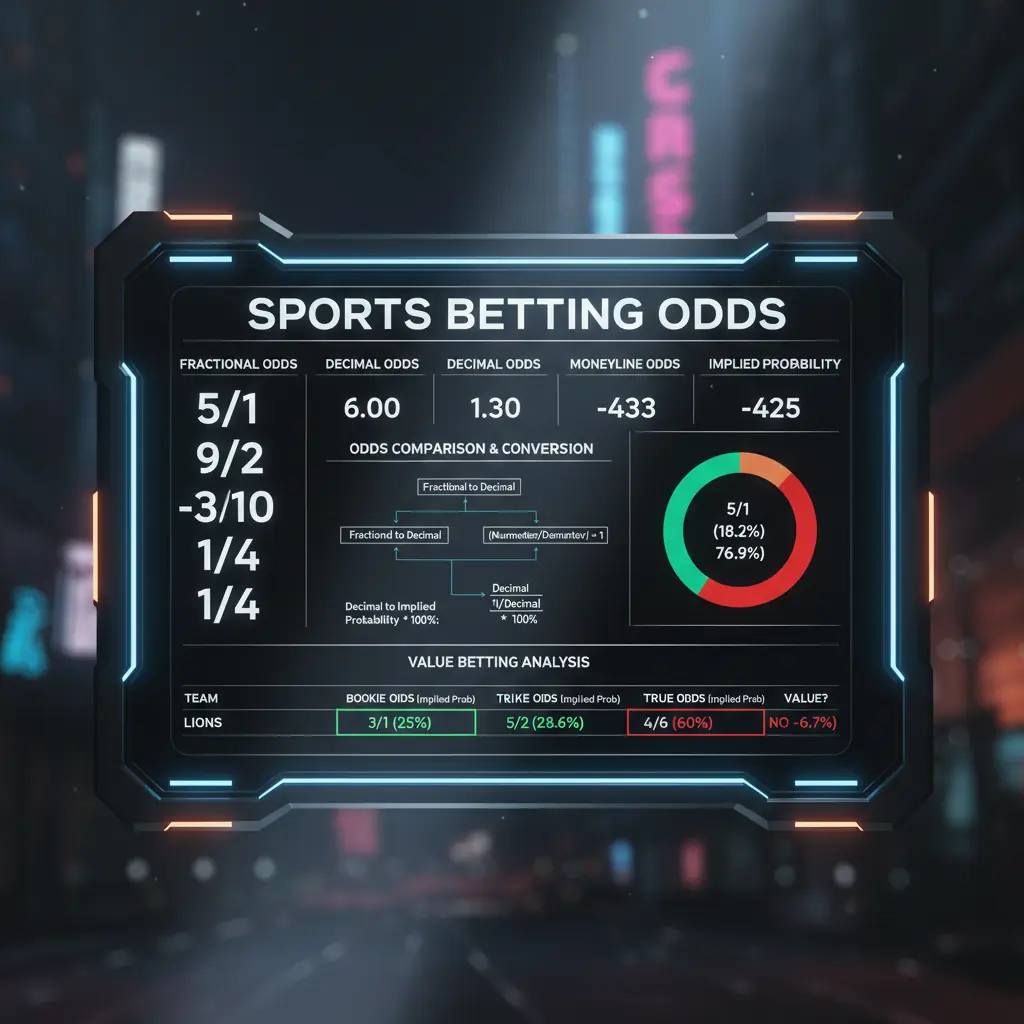
Calculating implied probability varies depending on the odds format. For decimal odds, the formula is straightforward: Implied Probability = 1 / Decimal Odds. For example, decimal odds of 2.0 translate to an implied probability of 50%. For fractional odds (e.g., 1/1), the calculation is: Implied Probability = Denominator / (Denominator + Numerator). Thus, 1/1 fractional odds also represent a 50% implied probability. American odds require a slightly different approach. If the odds are positive (e.g., +200), the formula is: Implied Probability = 100 / (Odds + 100). If the odds are negative (e.g., -200), the formula is: Implied Probability = Odds / (Odds + 100) -1.
It’s important to remember that implied probability always includes the bookmaker’s edge, often called the “vig.” The vig is the commission the bookmaker charges on every bet. This is why the sum of implied probabilities for all possible outcomes of an event typically exceeds 100%. For instance, in a tennis match, one player might have an implied probability of 55% and the other 50%, totaling 105%. This extra 5% represents the bookmaker’s profit margin, ensuring they make money regardless of the outcome.
Spotting Value: Finding an Edge in the Numbers
Value betting is fundamentally about identifying opportunities where your assessment of an event’s likelihood differs from that reflected in the available odds. It’s about believing you have an edge, a more accurate understanding of the true probability than the market does.
Assessing your own probability involves a multifaceted approach. It might begin with a deep dive into relevant statistics – team performance metrics, player statistics, head-to-head records, and any other quantitive data can inform your own probabilities. Stay updated on team news, injuries, weather conditions, and any other qualitative factors that could sway the outcome. Sometimes, intuition plays a role, particularly if you follow a sport closely and understand the dynamics involved. It’s about blending objective data with subjective insight to arrive at your own informed probability.
Once you have your probability, translate the betting odds into implied probabilities. This is key. Many websites offer tools to convert odds into implied probabilities. If your assessed probability is higher than the implied probability, you potentially have a value bet.
Positive expected value (+EV) is the holy grail of value betting. It means that, theoretically, if you were to place the same bet repeatedly, you would profit in the long run. This is how it works: Imagine you assess a team’s chance of winning at 60%, but the odds imply only at 45%. A +EV exists in this bias, betting here repeatedly gives a statistical edge.
For example, say your analysis leads you to believe Team A has a 70% chance of winning their match, but the bookmaker’s odds imply a 55% chance. This discrepancy suggests a potential value bet. Be aware that value betting is not a guaranteed path to riches. It requires diligent research, consistent application, and, above all, responsible betting practices. Manage your bankroll wisely, only risking what you can afford to lose, and never chase losses. Betting should be considered as entertainment and never as a source of income.
Monitoring Odds Movement: Reading Market Sentiment
Betting odds are not static numbers etched in stone. They are fluid, constantly changing reflections of perceived probabilities. These movements, often subtle but sometimes dramatic, can offer valuable clues about shifts in market sentiment and provide an edge to informed bettors.
A key factor influencing odds movement is news. A star player’s unexpected injury can send shockwaves through the betting market, causing the odds for their team to lengthen (become less favorable) almost instantly. Similarly, adverse weather forecasts can significantly impact the odds of an outdoor event. For example, a heavy downpour predicted during a baseball game might favor the team with the stronger bullpen, leading to a shift in the odds.
Savvy bettors also watch for “steam,” a sudden and significant movement in the odds, often triggered by a large influx of money from sharp bettors. Imagine a football game where the point spread suddenly jumps from -3 to -6. This could indicate that respected bettors have identified an advantage and are wagering heavily on one side.
To effectively monitor odds movement, bettors can utilize odds comparison websites and track line histories. However, it’s crucial to remember that odds movement is just one piece of the puzzle. While it can be indicative of valuable information, it should not be the sole basis for betting decisions. Sharp money doesn’t always win, and unforeseen circumstances can always change the game. By combining odds movement analysis with thorough research and informed judgment, bettors can increase their chances of success.
Advanced Strategies for Reading Betting Odds
Beyond the basics, advanced betting strategies demand a nuanced understanding of odds. These strategies aren’t for the faint of heart; they require careful calculation and a tolerance for risk, but can significantly boost potential profits.
Hedging Bets: This tactic involves placing a bet on the opposite outcome of your original wager to reduce risk or guarantee a profit. For example, if you bet on a team to win a tournament at the start, you might hedge your bet by wagering on another team before the final match. The odds at the time of the hedge determine its effectiveness; you need favorable odds on the opposing outcome to secure a guaranteed return or minimize potential losses. However, the risk is that the profit will be smaller than that of the original plan.
Correlated Parlays: A correlated parlay combines multiple bets that are related to each other. The success of one bet increases the likelihood of the other one to win. For example, betting on a team to win both the first half and the entire game of soccer. The payout is higher, but the correlation needs to be strong enough to justify the increased risk.
Arbitrage Betting: It exploits differences in odds offered by different bookmakers. By betting on all possible outcomes of an event across different platforms, you can guarantee a profit, regardless of the result. This strategy requires speed and access to multiple betting platforms to take advantage of fleeting opportunities. The profit margins are slim, but the risk is minimal.
Dutching: It involves calculating the precise amount to bet on each possible outcome of an event to guarantee the same profit, no matter which outcome wins. This is often used when there are multiple favorites in a race or competition. It requires careful calculation to determine the appropriate stake for each outcome.
Common Mistakes to Avoid When Reading Odds
Reading odds seems straightforward, but many bettors stumble into common traps. One frequent betting mistake is misinterpreting what the odds actually represent, leading to flawed betting decisions. Many also neglect to calculate the implied probability from the odds, failing to fully grasp the likelihood of an event occurring. Ignoring the bookmaker’s edge (the vigorish or juice) is another pitfall, as it skews the true probabilities. To avoid these errors, always double-check calculations and understand implied probability. Moreover, don’t let emotions dictate your bets; rely on rational analysis. Finally, failing to shop around for the best lines across different sportsbooks can leave money on the table. Pro bettors always understand that line shopping is critical for long-term success.
Conclusion
Mastering the language of betting odds is the cornerstone of betting success. It empowers you to make informed decisions and unlock more profitable wagering opportunities. Understanding the nuances of each format, effortlessly converting between them, and calculating implied probability are vital skills for identifying value and making smarter bets. Embrace continuous learning, practice responsible gambling, and confidently apply your newfound knowledge. The rewards of odds mastery are within reach, paving the way for a more strategic and potentially lucrative betting journey.